A. Roles played in the Centre:
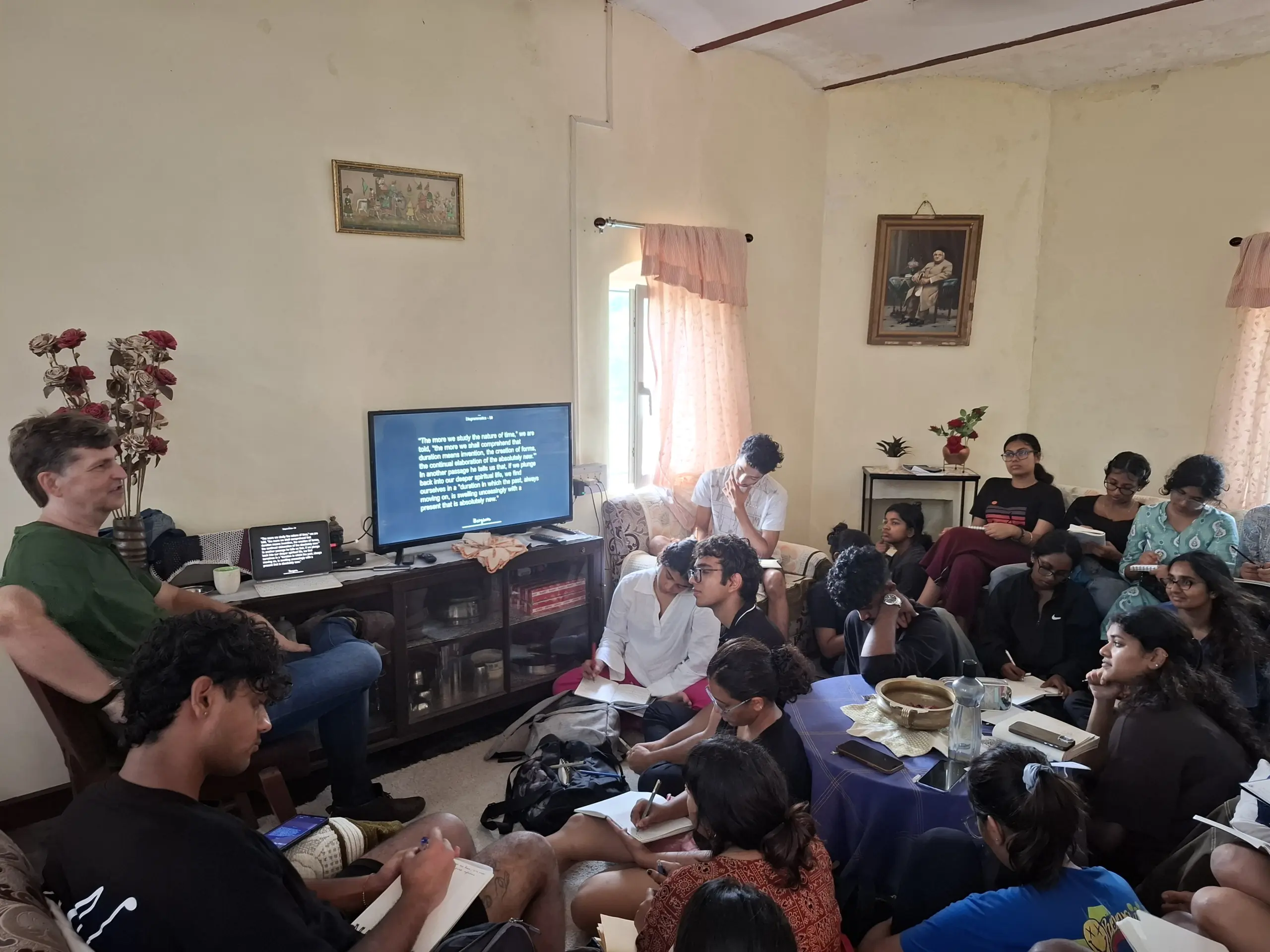
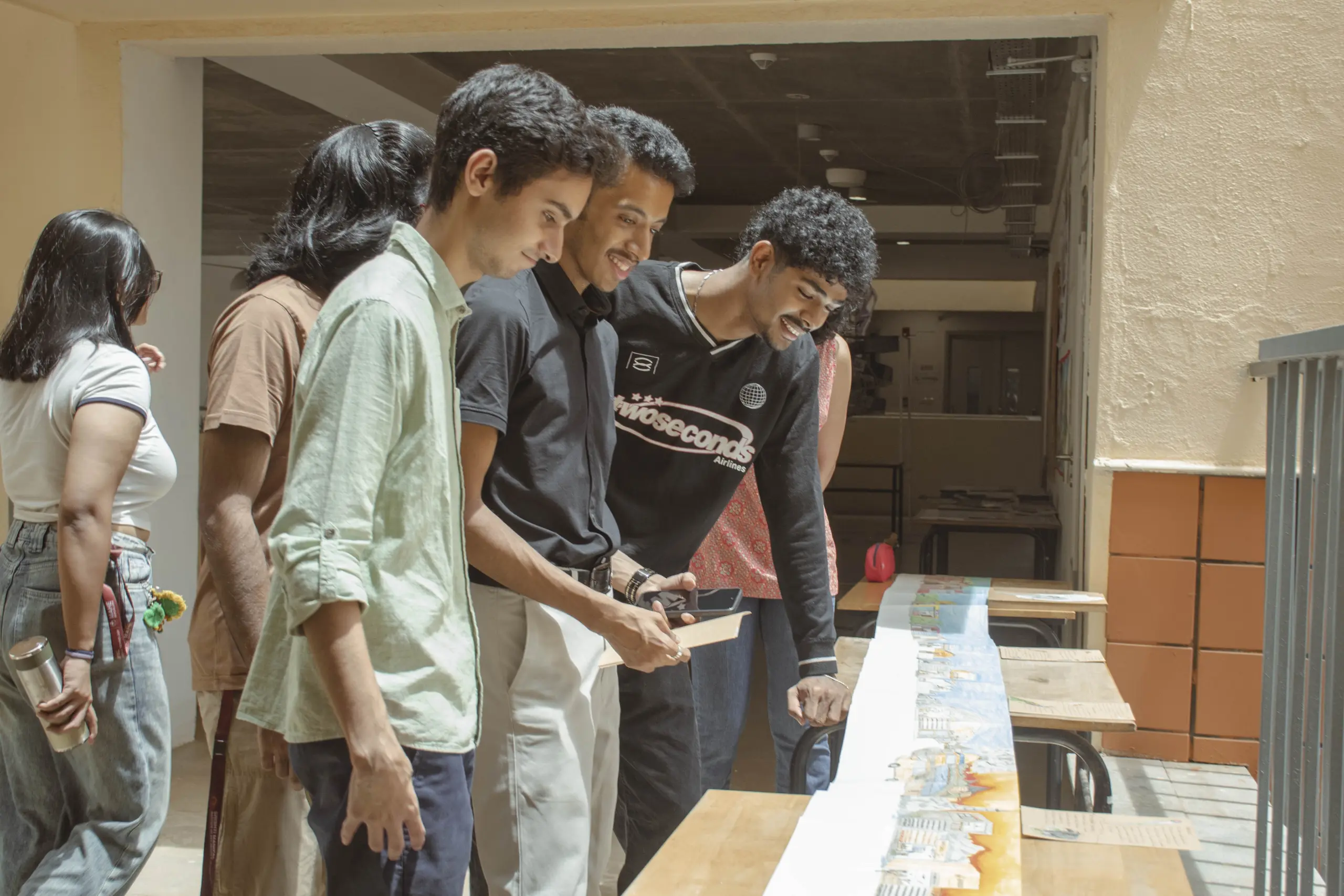
At the Centre for Reimagining Transitions, Divyarajsinh has contributed across multiple capacities — as a member of the envisioning committee and a doctoral research scholar. He is in the process of completing his PhD tenure. Since the Centre’s establishment in 2022, he has supported its growth by assisting principal investigators with transdisciplinary projects and advancing his own transdisciplinary doctoral research, contributing to new inquiries in Transition Studies. He has also strengthened the centre’s national and international presence through conference presentations, global network-building, and knowledge production through publications, design studios and research initiatives.
B. CRT’s Contribution Research Areas:
I. Focus Area:
With a core focus on Systems and Relational Futures, Divyarajsinh’s work extends across two interconnected domains within the Centre for Reimagining Transitions: Education and Pedagogy and Technology in a Transitioning World. His approach integrates these domains to reimagine design in both pedagogy and practice, as a paradigm shaping human-nature relations and as a ‘deep’ leverage point for societal transitions towards more relational futures.
At CRT, his research advocates for a systemic transition from sustainability to relationality. He positions the conventional notion of sustainability as rooted in what Escobar terms a “one-world ontology”—a worldview that treats nature primarily through a utilitarian lens, valuing it insofar as it sustains human life, economies, and future generations. This anthropocentric logic and dichotomies between society and nature, human and nonhuman, are also mirrored in contemporary and sustainable modes of design, production, and consumption, and fail to challenge the extractive systems driving the socio-ecological crisis. Relationality offers an alternative grounding, one that recognises the deep entanglement of human and non-human life and opens space for the pluriverse and radically alternate ways of relating to the living world.
His work pushes toward relationality in design—understanding design not as a problem-solving process or as the imposition of form onto matter, but as a practice of attunement to the living systems, communities, and more-than-human worlds in which it intervenes. Rather than optimising systems for human benefit, relational design asks what it means to design with and from within the web of human-nature relationships that constitute a socio-ecological context, and how design might support transition to relational living that sustainability alone cannot imagine.
II. The Transition Framework of Focus Area for CRT:
- The transition framework embedded in Divyarajsinh’s focus area is primarily ontological — a shift from the dominant “one-world ontology” that underlies conventional sustainability paradigms, toward a relational worldview that recognises the deep entanglement of human and more-than-human life.
- At its core, drawing on relational design and design for pluriverse theory, this framework calls for a reorientation of design itself—from a problem-solving discipline oriented around human needs and systemic optimisation, to a practice of attunement to the living systems, communities, and ecologies in which it intervenes.
- In keeping with transition studies and systems thinking, the framework positions design not as a surface-level intervention but as a deep leverage point—a regenerative and critical practice that can prototype, enact, and iterate toward relational futures.
- The framework extends across two interconnected domains—Education and Pedagogy and Technology in a Transitioning World—exploring how relational futures can be cultivated through new pedagogical practices, such as wild pedagogies, and critically reoriented emerging technologies.
- In alignment with CRT’s vision, the framework engages non-dominant and Indigenous knowledge traditions to rethink the nature-society dualism and the human-nonhuman binary that underpin extractive systems, opening space for relational ontologies and alternative ways of relating to and inhabiting the living world.
III. Thrust areas:
- Ontologies of Transition
Examining the worldviews and assumptions embedded in dominant design paradigms, and investigating relational, pluriversal, and more-than-human ontologies as foundations for deeper socio-ecological transition.
- Design as a Leverage Point for Systemic Change
Positioning design as a deep leverage point for societal transition, capable of shifting the paradigms, worldviews, and relational structures that underlie current socio-ecological systems.
- Pedagogy for Relational Futures
Reimagining design education and pedagogical practice as sites for cultivating relational sensibilities, pluriversal thinking, and transitions in how human-nature relations are understood, taught, and enacted.
- Technology, Ecology, and Transition
Critically engaging with technology’s role in reproducing or transforming extractive human-nature relationships and exploring how design can reorient technological systems toward ecological embeddedness and relational living.
- Place, Ecology, and Situated Practice
Exploring how relational design thinking is grounded in specific socio-ecological contexts, attending to place, community, and the more-than-human as generative starting points for transition-oriented inquiry and making.
C. Teaching–Research Integration:
I. Framework of Teaching-Research Integration followed:
- Incorporating CRT knowledge transition framework in UG Studio Projects
- Incorporating CRT knowledge transition framework in Transdisciplinary Projects involving Master’s 1st year and 2nd year students.
- Incorporating CRT knowledge transition framework in PGDP Final Projects.
II. Outputs of Individual Mentoring in Research Projects:
- PGDP Principal-supervisor for Final Project Dissertation (2025) – Diya Haneena
Topic: ‘First Children of the Soil – A Sculptural Translation of Santhal Totemic Worldview’ (completed).
- PGDP Principal-supervisor for Final Project Dissertation (2025) – Edwin J Edayodi
Topic: ‘Design for Empowerment–Inquiry into UI/UX design for Papier mache crafts of Jammu & Kashmir’ (completed).
- PGDP Principal-supervisor for Final Project Dissertation (2025) – Duhitha Srinivas, Topic: ‘Beyond Adornment – Exploring Women’s Intra-Relationships with Marital Jewellery’ (completed).
III. Units taught in CRT Framework:
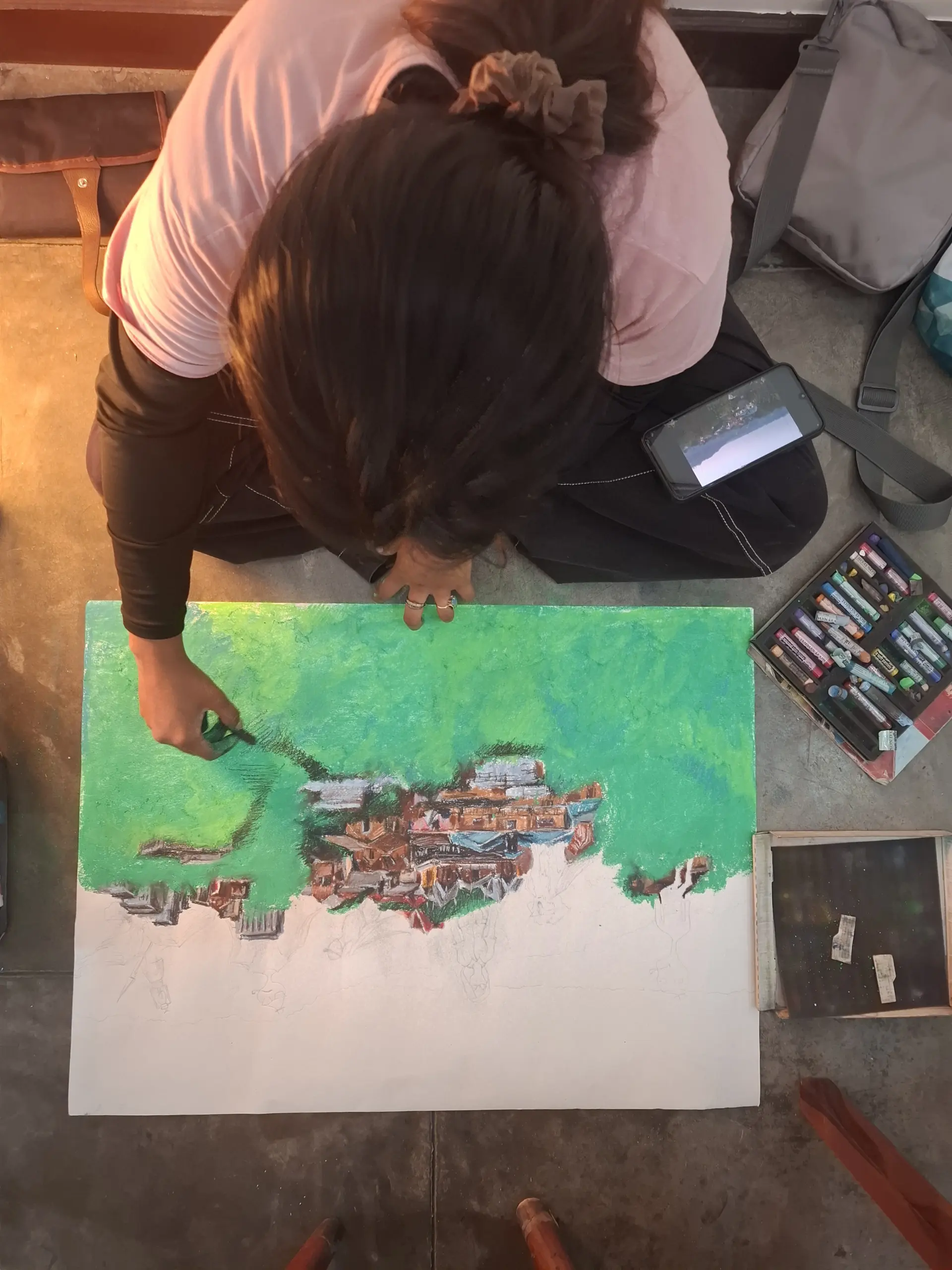
- Information & Storytelling: Unit offered in Information Arts and Information Design UG curriculum.
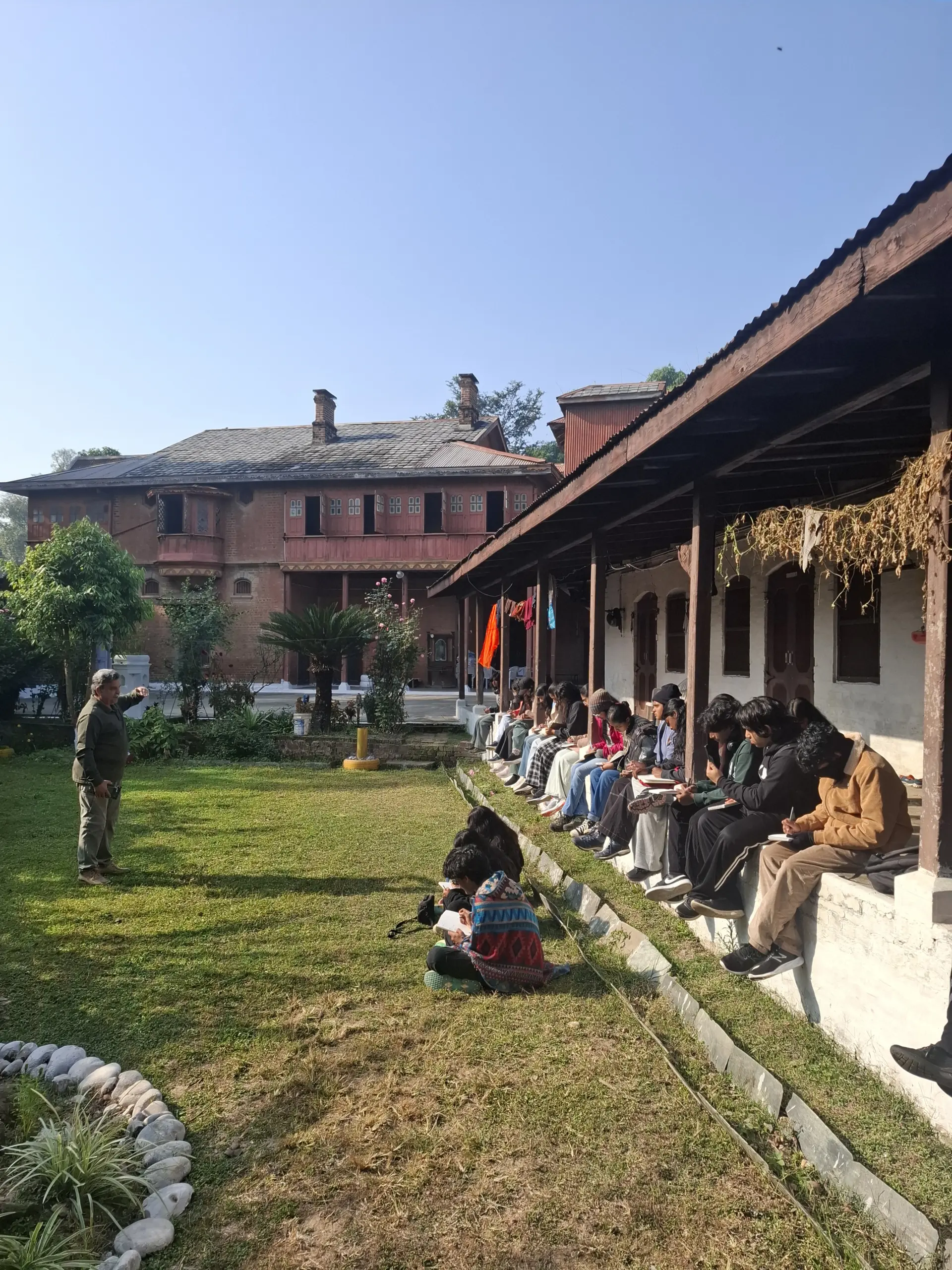
- Study of Social Ecology: Place-based, immersive unit offered as part of the UG Foundation Studies curriculum.
- Theory & Understanding/Seminar: A theory and research engagement unit offered as part of the PGDP/PG curriculum.
D. Outputs, Public Engagement & Impact:
I. Publications:
- Rana D, Chakraborty K and Kalyanasundaram S (2025) Spatio-artistic thresholds foster human-nature connections for sustainable transitions: cases of vernacular facades in Bhal, India. Front. Sustain. Cities 7:1533006. doi: 10.3389/frsc.2025.1533006
- Rana D, and Chacko J. Chapter- Rewilding Art & Design Education: A Pedagogical Framework for Fostering Partnerships with Nature. In Urban human-nature partnerships – From the Anthropocene to the Ecocene. (In press)
II. Public-Facing Engagements:
- [Conference, 2023] ‘Reimagining Architectural Transitions: More than human approach towards transitions in vernacular architecture’, presented at the 8th Network of early career researchers in Sustainability Transitions (NEST) conference, organised by Leibniz Institute of Ecological Urban and Regional Development at Dresden, Germany, from 30th June – 1st July 2023.
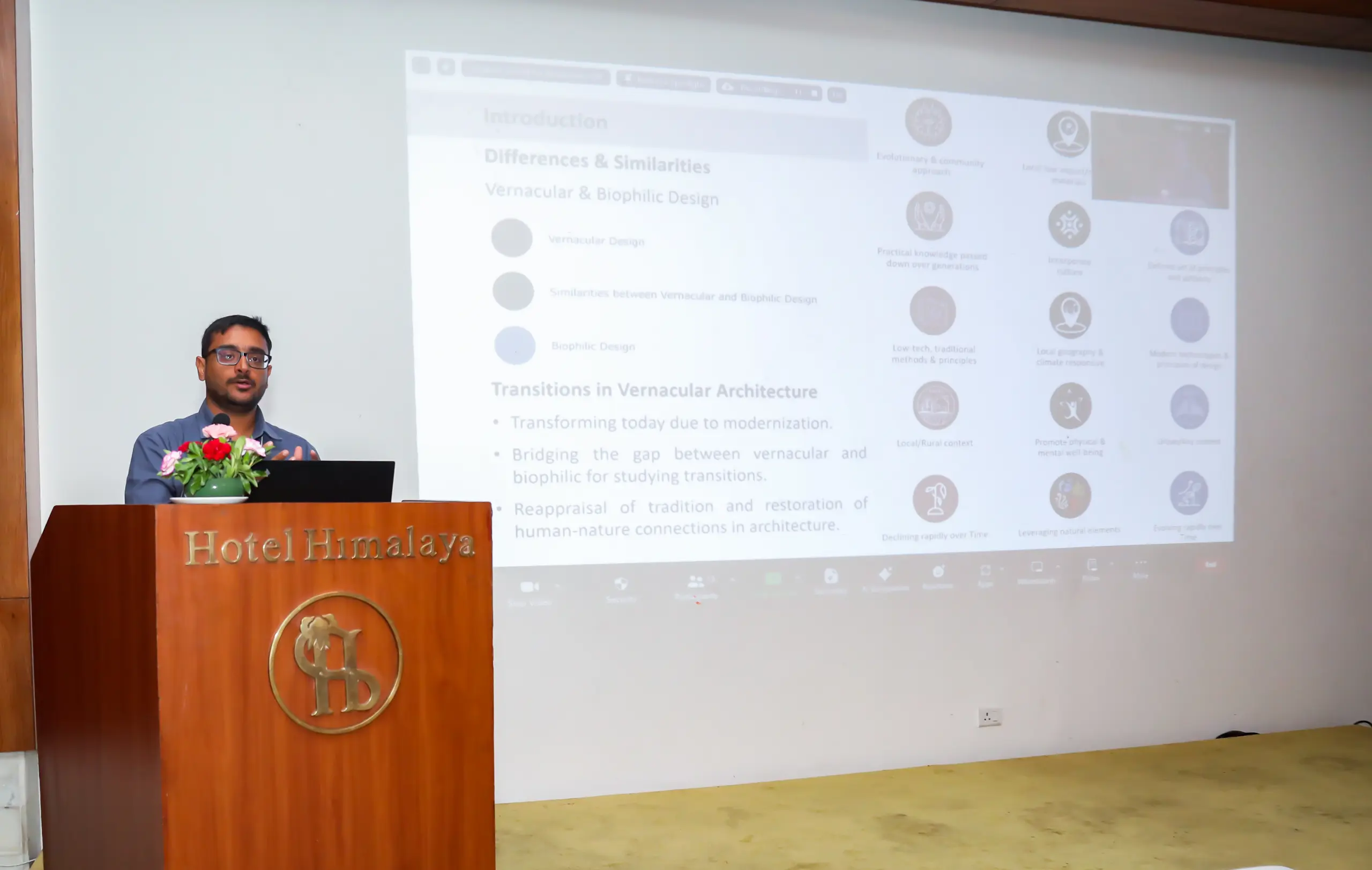
- [Conference, 2024] ‘Reimagining Design for Sustainability: Biophilic Design as a Framework for documenting human-nature Transitions in vernacular dwellings’, presented at the 30th International Sustainable Development Research Society (ISDRS) Conference, organised by Mid-West University Institute of Cooperation and Development at Kathmandu, Nepal, from 11th-13th June 2024.
- [Conference, 2024] ‘Reconnecting Humans with Nature: Reimagining traditional Indian art & architecture for sustainability transitions’, presented at the 15th International Sustainability Transitions (IST) Conference, organised by the University of Oslo at Oslo, Norway, from 16th-20th June 2024.
E. Research Networks & Collaborations:
I. Core Team Member, Art–Science Thematic Group, Sustainability Transitions Research Network (https://www.transitionsnetwork.org/thematic-groups/art-science/)