A. Roles played in the Centre:
Principal Investigator
B. CRT’s Contribution Research Areas:
I. Focus Area:
Dr Dyutiman Mukhopadhyay’s work at CRT focuses on the transition in knowledge systems and proposes a paradigm shift in the currently valid Western “scientific” enquiry methods. It seeks to incorporate and apply the principles of Indian Philosophy of Science as they were prevalent before the spread of the European Scientific Revolution and its colonial aftermath. The tools for this research are mostly ‘a-disciplinary’, universal questions that delve into the shared complexities of knowledge across the arts and sciences, highlighting the nature of truth and evidence that transcends disciplinary boundaries.
The scope of the word “empiricism”—which means gaining knowledge through experience—has often been restrained and reduced to “quantifiable evidence”. The age-old debate between the objectivity of scientific inquiry and the subjectivity of artistic processes has often been oversimplified, perpetuating the misconception that science is purely objective while art is inherently subjective. However, a closer examination reveals a common epistemological challenge that both fields grapple with.
Dr Mukhopadhyay’s work on the neuropsychology of the ‘aesthetic paradox’, in which he proposed the ‘Dual-Phase-Oscillation hypothesis’ (Mukhopadhyay, 2014), has been featured in literary theory and emotion research. His other major work concerns the characterisation of functional brain networks and emotion centres, based on the Rasa theory of ancient Indian aesthetics (Mukhopadhyay et al., 2022; Tripathi et al., 2020). His critical review of the neuro-philosophy of archetype in visual aesthetics, published in English, has been translated into Russian by the Moscow Association of Analytical Psychology (Mukhopadhyay, 2014/2019). He also works on the cultural models of ‘self’ and social appraisal, using naturalistic stimuli such as films, through the lens of cross-cultural, social, and personality psychology, conversing with philosophy and epic narratives (Mukhopadhyay, 2026) and reimagining cross-cultural aesthetics through indigenous paradigms (Darda, Mukhopadhyay & Singh, 2026).
II. The Transition Framework of Focus Area for CRT:
- The transition framework embedded in Dr. Mukhopadhyay’s focus area is primarily based on knowledge transition, which is inner and epistemic—a shift from habitual, retrospective cognition to a deeper inquiry into temporal immediacy, memory distortion, and the fluidity of embodied experience.
- At its core, this knowledge transition is not merely in the content of what is known, but in how knowledge is perceived, embodied, and expressed. This transition emerges through a critical reorientation of cognitive habits shaped by modern epistemologies and a complementary engagement with Indian philosophical traditions on cognition, perception, and emotion.
- In keeping with CRT’s ethos, the work refrains from framing Indian and Western paradigms as binaries, instead exploring how their juxtaposition reveals epistemic gaps and bridges—especially in relation to aesthetic experience, temporality, and self-reflection.
III. Thrust areas:
- Presumptive truths and uncertainties in scientific evidence.
- Consciousness and the nature of reality.
- Artistic inquiry and subjectivity.
- Alternative methodologies in scientific experimentation.
- Re-interpreting the “unaccepted” paradigms in scientific inquiry.
C. Teaching–Research Integration:
I. Framework of Teaching-Research Integration followed:
- Incorporating CRT knowledge transition framework in Transdisciplinary Projects involving Master’s 1st year and 2nd year students.
- Incorporating CRT knowledge transition framework in Master’s Final Capstone Projects.
- Incorporating CRT knowledge transition framework in Inter-departmental interlude Master’s projects.
- Incorporating CRT knowledge transition framework in PhD guideship.
II. Recent CRT-related Outputs of Individual Mentoring in Research Projects:
- PhD Principal Supervisor (2025 onwards) – Mudita Mehta; Topic: ‘Embodied Engagement in Pottery‘ (in progress; preparing for Institutional Protocol Approval Committee [IPAC] presentation).
- PhD Co-supervisor (2025 onwards) – Chaitra HG; Topic: ‘Towards creating a new musical format in Hindustani new age Classical Music’ (in progress; preparing for Institutional Protocol Approval Committee [IPAC] presentation).
- PG Principal-supervisor in Transdisciplinary Research Project (2026) – Shivika Kumar, Ranjita Choukimath, Thanga Dhanush; Topic: ‘Social Cognitive Camouflage: Masking, Norms, Identity, and the Designed Self ‘ (in progress).
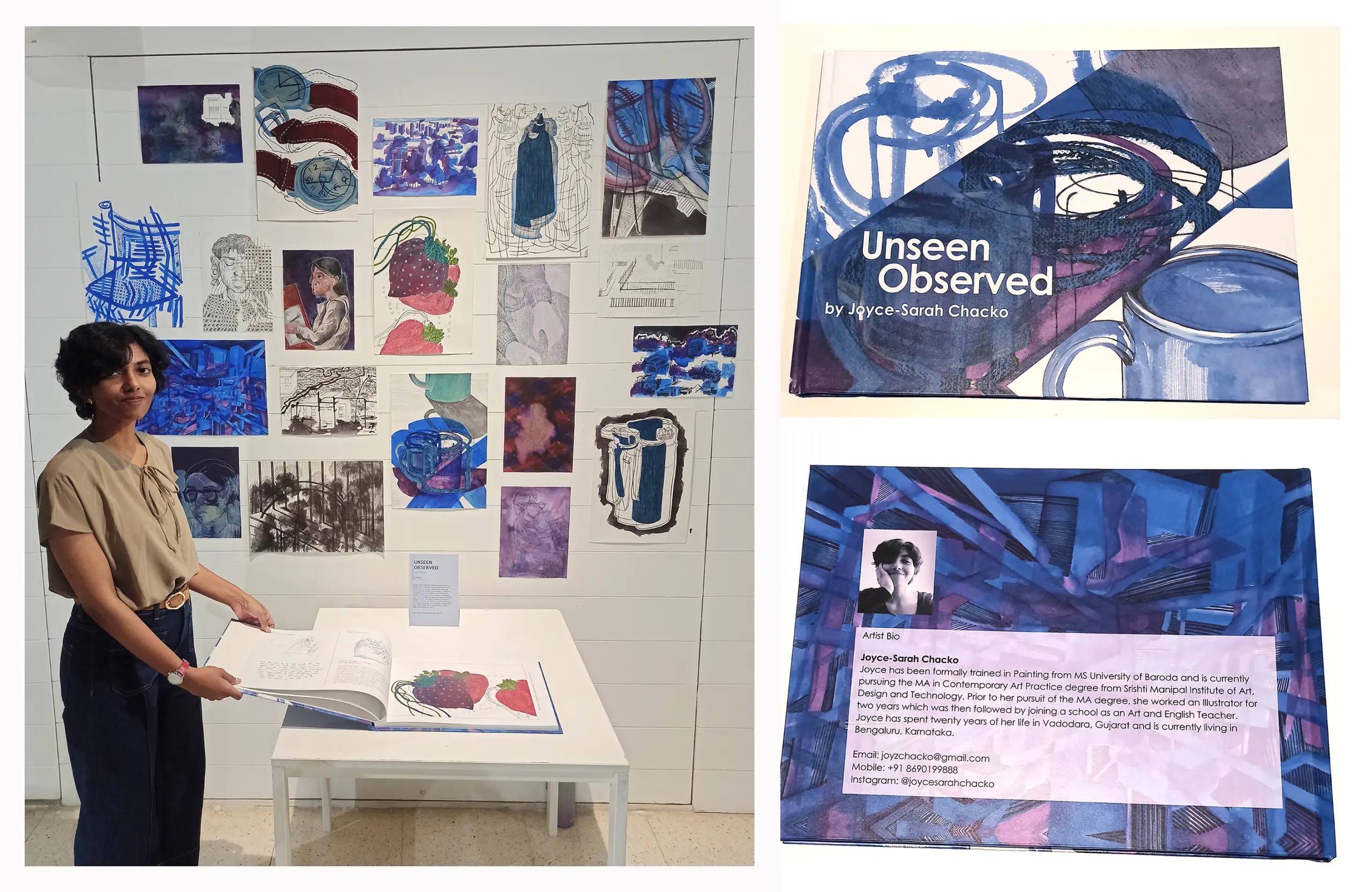
- PG Principal-supervisor in Transdisciplinary Research Project (2025) – Joyce Sarah Chacko, Hiral Singh Chahar, Anwesha Paul, Sunakshi Shailendra Nigam, Antara Mittal, Meghana Nevatia; Topic: ‘The reflective divide: the confounding problems of journaling the art experience in real time and after‘ (completed).
- PG Principal-supervisor for Final Capstone Project Dissertation in Information Arts and Information Design Practice (2025-2026) – Sunakshi Shailendra Nigam; Topic: ‘Madness as Method: A personal journey with psychosis and poetry‘ (completed).
- PG Principal-supervisor for Final Capstone Project Dissertation in Information Arts and Information Design Practice (2023-2024) – Meghana Miriyala; Topic: ‘Exploring the socio-cultural-religious identity dilemma of the modern Indian youth through a design intervention‘ (completed).
- PGDP Principal-supervisor for Final Project Dissertation in Information Arts and Information Design Practice (2025) – Nirupama Shankar Babu Thirugnanam; Topic: ‘Development of Synergetic Threads – Ancient Wisdom Interwoven: a comparative mysticism oracle deck and guidebook‘ (completed).
- PGDP Principal-supervisor for Final Project Dissertation in Information Arts and Information Design Practice (2024) – Naveena Sivakumar; Topic: ‘Patterns of Identity: textile design elements inspired by the Badaga community of Nilgiri Hills in India‘ (completed).
- PGDP Principal-supervisor for Final Project Dissertation in Information Arts and Information Design Practice (2024) – Shree Agrawal; Topic: ‘Mahabharata’s Draupadi: a visual narrative of her societal impact in contemporary India‘ (completed).
- PGDP Principal-supervisor for Final Project Dissertation in Information Arts and Information Design Practice (2024) – Olivia Chakraborty and Shaurya Dagar (collaborative thesis); Topic: ‘Poetics, Storytelling, and the Archetypal Psychology of Bengal Embroidered Quilt (Nakshi Kantha) of India‘ (completed).
III. Units taught in CRT Framework:
- 2024-2025: Rethinking Information: Cognition, Emotion, and Experience: Unit offered in Information Arts and Information Design PG curriculum.
- 2024-2025: Immersive Media Studio: Unit offered in Information Arts and Information Design PG curriculum.
- Information Dynamics of the future: Unit offered in Information Arts and Information Design PG curriculum.
D. Outputs, Public Engagement & Impact (Representative):
I. Recent CRT-related Publications & Artistic Outputs / Recognitions:
- [Book Chapter] Mukhopadhyay, D. (2026) ‘”Indianness”, the “Self”, and the Validation Problem: Experimental Psychology in Conversation with Philosophy, Epic Narratives, and Aesthetics‘, in Handbook of Indic Philosophy and Religion: Classical Past and Modern Histories, Guha, N. and Mukherjee, S. (eds.), Bloomsbury Publishing, 267–328. https://www.bloomsbury.com/in/handbook-of-indic-philosophy-and-religion-9789361313318/
- [Journal Article] Darda, K. M., Mukhopadhyay, D., Chatterjee Singh, N. (2026) ‘Reimagining Empirical Aesthetics Through Cross-Cultural Perspectives‘, Current Opinion in Psychology, Vol. 72: 102401. https://doi.org/10.1016/j.copsyc.2026.102401
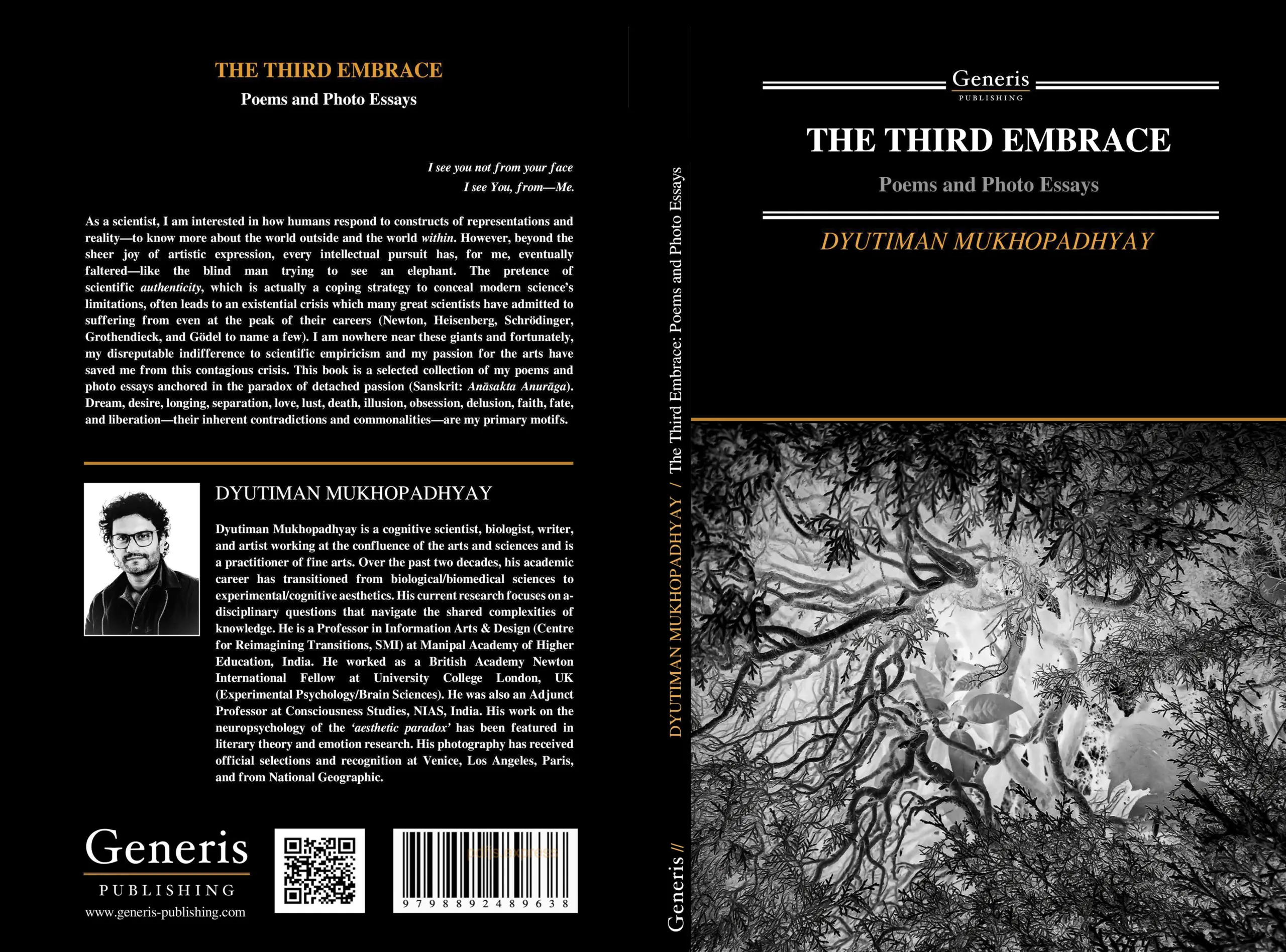
- [Book] Mukhopadhyay, D. (2025) ‘The Third Embrace—Poems and Photo Essays’, BAYSHOP INC-USA (Generis Publishing), ISBN: 979-8-89248-963-8.
- [Short film] ‘3 Long Takes Dedicated to Abbas Kiarostami’: Honourable Mention Award (and screening) for the Best Experimental Short Film at Berlin Indie Shorts Festival, Germany, 2025; Nominee (top six) for the Best Experimental Short Film at the 14th Film Olympiad Grand Prix, 2025, Athens, Greece; Official selection at Muses Film Awards – Levadia International Film Festival, Greece, 2026
- [Short film] ‘Dropped Frames’: Quarterfinalist, official selection, and screening at Berlin Indie Shorts Festival, Germany, 2025.
II. Recent CRT-related Public-Facing Engagements:
- [Invited Talk, 2026] ‘Art and Emotion: Neuropsychology, Neurophilosophy, and Experimental Aesthetics’, addressed at the International Conference on Clinical Neuropsychology and Clinical Neurosciences (ICNCNC 2026), at the National Institute of Mental Health and Neuro Sciences (NIMHANS), Bengaluru, India, from 5th to 7th March 2026.
- [Invited Talk, 2026] ‘The Puzzle of Art Experience: Lived Encounters and Cognitive Aesthetics’, addressed at India’s first Neuroaesthetics Unconference 2026 (Theme: Beauty: Aesthetics, Identity, and Mental Health), held in Pune, India, from March 27 to 29, 2026.
- [Invited Talk, 2024] ‘Using films in experimental psychology to understand social appraisal and cultural models of self’, International Seminar—Christ University, School of Psychological Sciences, Bengaluru, India and Dept. of Psychology, University of Oslo, Norway; 12 December 2024.
- [Invited Talk, 2024] ‘The Image in Context: Exploring Narrative, Colour, and Context through Photography’, Residency Workshop, Dept. of Cognitive Science & Dept. of Humanity & Social Sciences, Indian Institute of Technology, Gandhinagar; February 10-11, 2024.
E. Collaborators/Partnerships:
IIT Gandhinagar, Gujarat; NIMHANS, Bengaluru; NIAS, Bengaluru; ARISA Foundation, Pune