

Srishti Manipal Institute of Art, Design and Technology, for the last thirty years, has been practicing an integrated learning model that brought together Art, Design, and Technology within a choice-based framework. What began as a bold educational experiment has now become a tangible and inspiring model of learning adopted across undergraduate programs in the country.
While the NEP and NSQF frameworks focus on reforming education systems to align with professional and industrial environments, Srishti has always envisioned education as a space that extends beyond the immediate demands of industry and the workplace. For us, education is not just about preparing for a career, it is about nurturing the ability to shape the future. The future, therefore, is not something to arrive at. It is something we create, a future that builds new opportunities, strengthens communities, and fosters deeper connections with the world.
Focus Area Studies - FASt
In this spirit, the community of practitioners at SMI have explored emerging possibilities and envisioned a set of learning models called Focus Area Studies (FASt). FASt initiatives are rooted in the realities of a rapidly changing world, responding to crises of the present, the opportunities brought by technological advancement, and the ethical, ideological, and philosophical dilemmas of both material and digital cultures.
FASt units are offered after the completion of the one year Foundation Studies Program, which introduces students to diverse facets of art and design practice. These units, situated at the intersections of multiple disciplines, provide deeper grounding in emerging fields that are still evolving areas that have yet to become established disciplines in their own right.
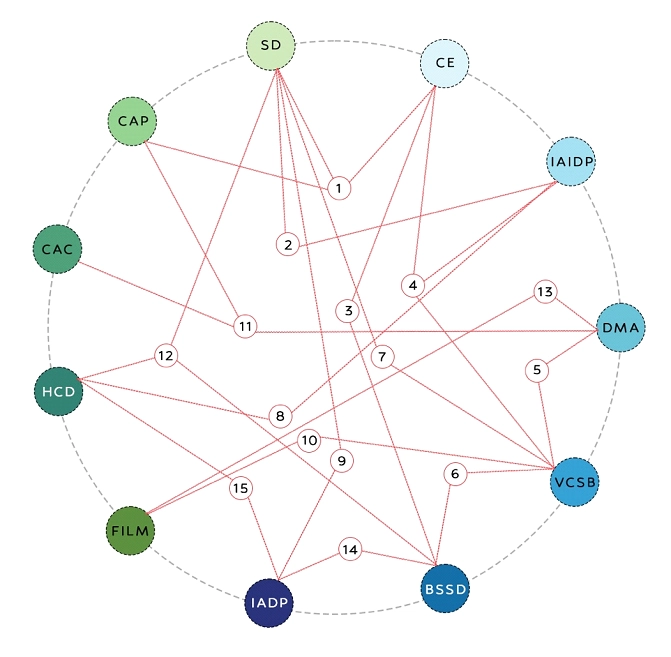
The fifteen FASt’s envisioned through the collaborative exercise between the eleven courses offered at SMI. They are:
1. Art, Place and Society
Collaborators: Spatial Design, Contemporary Art Practice and Creative Education By working with communities through hands-on, contextual, and media-based interventions, learners develop a practice grounded in social, cultural, and ecological understanding.
2. Community Environments
Collaborators: Spatial Design, and Information Arts and Information Design Practices
A participatory, ecologically attuned approach that blends spatial and information design to shape inclusive and responsive community environments.
3. Leading Change
Collaborators: Business Service and System Design and Creative Education A space for cultivating creative changemakers who integrate strategic thinking, public practice, pedgogy and policy insight to build equitable and sustainable futures.
4. Playing Field
Collaborators: Visual Communication and Strategic Brading, Information Arts and Information Design Practices and Creative Education as an emerging field, play is increasingly understood as a powerful mode of thinking, creating, and co-designing possibilities that enable lifelong learning, adaptation, and new ways of being.
5. Sequential Narratives
Collaborators: Visual Communication and Strategic Brading and Digital Media Arts Blending research and practice, the focus area immerses learners in the tools and processes of creating compelling graphic narratives, with a strong emphasis on South Asian vernacular forms and publishing ecosystems.
6. Service and Branding
Collaborators: Visual Communication and Strategic Branding and Business Service and System Design By aligning well-designed systems with effective communication, the focus area enables the co-creation of adaptable, future-ready services across diverse sectors.
7. Spatial Experience Design
Collaborators: Visual Communication and Strategic Branding and Spatial Design
By exploring the interplay of space, media, materiality, and sensory design, it equips learners to conceptualize and curate memorable experiences across exhibitions, retail, events, and branded environments.
8. More Than Human World
Collaborators: Information Arts and Information Design Practices and Human Cantered Design
By integrating non-human perspectives, local knowledge systems, and critical, participatory design, the focus area cultivates holistic ways of imagining regenerative futures beyond human-centric frameworks.
9. RE-SHAPE the Future of Living
Collaborators: Industrial Art and Design Practices and Spatial Design
By blending spatial design with furniture, lighting, textiles, and craft, it nurtures material sensibilities and sustainable thinking to deliver thoughtful, healthy, and circular interior environments.
10. The Art of Persuasion: Promotional Stories for Screen
Collaborators: Visual Communication and Strategic Branding and Film This FASt rethinks promotional films by experimenting with evolving media and strategies, emphasising ethical messaging and creating collectively aware, short, impactful narratives.
11. Expanded Media Arts
Collaborators: Contemporary Art Practice, Creative and Applied Computation and Digital Media Arts By merging computation, performative media, and interactive environments, this focus area redefines how stories are created and experienced across collapsing physical–digital spaces.
12. Urban Systems
Collaborators: Business Service and System Design, Spatial Design and Human Cantered Design
This focus area uses systems thinking, human-centred design, and data-driven analysis to understand and reshape urban environments, preparing learners to create resilient, liveable city futures.
13. Aesthetics of the Hybrid
Collaborators: Digital Media Arts and Film
This focus area opens up a space for multiplicity and experimentation, using unconventional image-making methods to craft hybrid cinematic experiences across physical, digital, and generative realms.
14. Textile Futures– Ecology, Economy and Regenerative Design
Collaborators: Industrial Art and Design Practices and Business Service and System Design
A systems-led, regenerative approach that blends craft heritage and modern innovation to envision circular and collaborative futures for the textile ecosystem.
15. Future of Making
Collaborators: Industrial Art and Design Practices and Human Cantered Design This focus area explores how hands-on tinkering with emerging technologies— from IoT and wearables to AR/VR—can drive speculative, inclusive, and future-oriented design for both physical and virtual contexts.